Deterministic Consent Gate: analytics remain disabled until explicit opt-in. No third-party trackers are loaded.

NPU Manifesto Series / White Paper

CASE STUDY:
PROJECT RESILIENT EDGE

Autonomous Off-Grid Logistics, Energy Trading, and EMP-Hardened Infrastructure

An active R&D architecture for continuity under utility denial, electronic warfare, and infrastructure degradation.

Document ID: NPU-WP-2026-12

Edition: Mathematical and Global Architecture Update

Audience: CTOs, Operations Directors, Risk Architects

Author: R&D Engineering Group, Ne Plus Ultra Global Solutions

Executive Summary

Global supply chains, utility grids, and transaction layers are systemically vulnerable because they rely on centralized communication and settlement rails. Kinetic attacks, internet blackouts, and electronic warfare can interrupt continuity in minutes.

Project Resilient Edge is anchored by the Banka Citadel test facility and combines RF mesh networking, EMP-hardened root nodes, LEO bridging, DAG-native settlement, and edge-computed robotics into a parallel resilience stack.

By operating outside public tower and centralized banking chokepoints, the architecture establishes a benchmark for operational redundancy, financial sovereignty, and off-grid resource distribution.

1. Theoretical Framework: The Mathematics of Infrastructure Collapse

1.1

Network Theory: The Vulnerability of Centrality

Centralized infrastructure behaves as hub-and-spoke topology with high betweenness centrality. Hub removal or edge severance can rapidly fragment the graph and collapse throughput.

Countermeasure: Citadel architecture uses distributed mesh topology with no single point of survivability failure. Node loss raises path length only marginally.
1.2

Information Theory: Shannon Capacity and State Censorship

Adversarial censorship attacks channel capacity by reducing available bandwidth or increasing effective noise through jamming and transport denial.

Countermeasure: Chirp Spread Spectrum LoRa transport and resilient routing preserve communication under adverse SNR, sustaining sufficient channel capacity for decentralized state coordination.

C = W log2(1 + S/N)
1.3

Game Theory: The Coercion Equation

Compliance systems can be modeled as expected utility optimization where surveillance and account controls raise punishment cost and suppress coordination.

Countermeasure: Air-gapped tooling, DAG settlement, and autonomous edge logistics reduce coercive leverage by minimizing exposed metadata and centralized control points.

Ur = p * V - (1 - p) * Cp

2. Technical Topology: The Sovereignty Stack and Citadel Federation

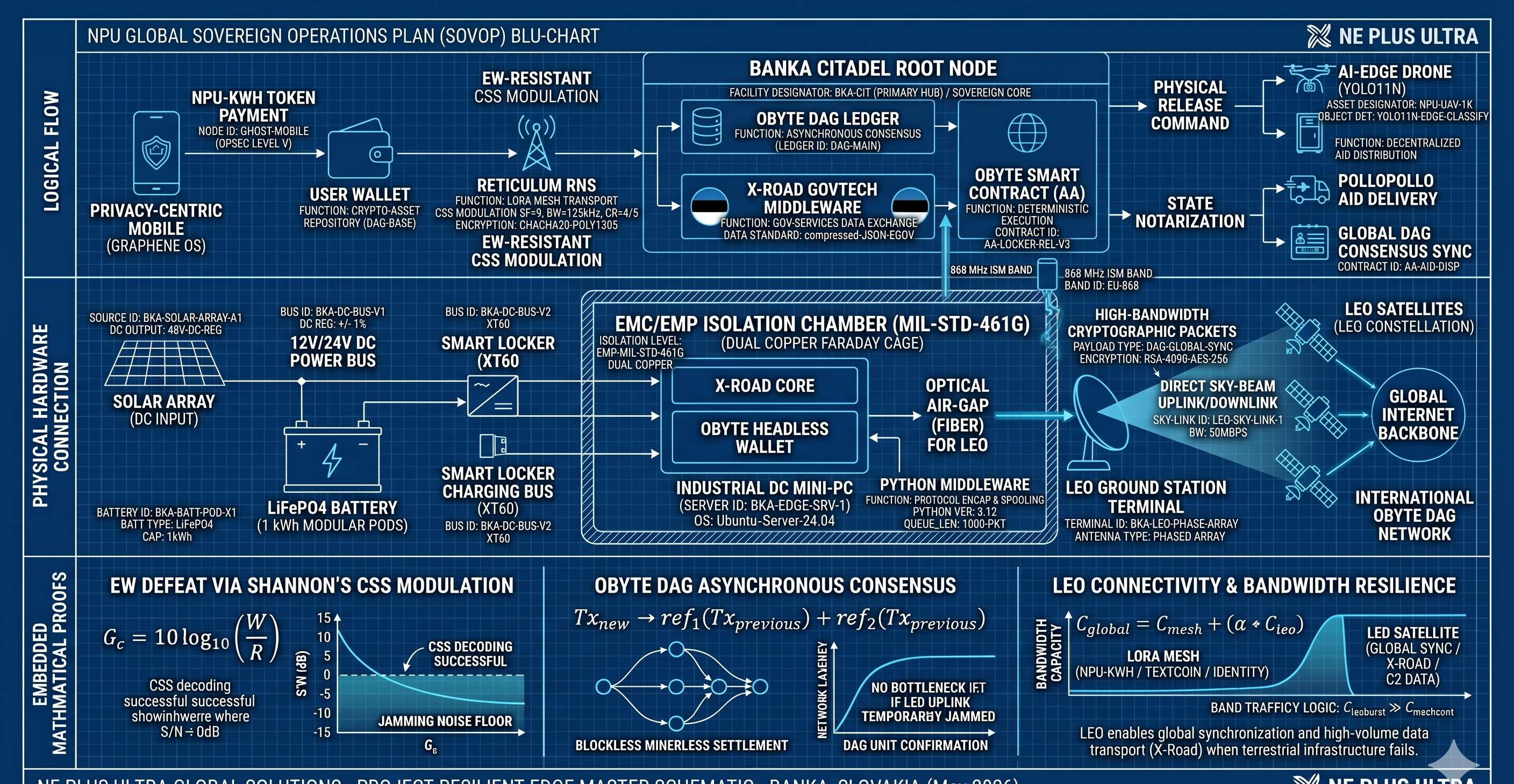
Banka Citadel Sovereign Operations Architecture Diagram

2.1 Physical Layer: RNS Mesh and Citadel Macro-Mesh

  • Routing operates on the EU868 ISM band with Heltec-class transceivers and Reticulum transport.
  • Duty-cycle constraints are respected through compact payload design and efficient routing behavior.
  • Citadel hardware is hardened via layered Faraday isolation, TVS-regulated ingress, and optical decoupling to prevent conductive attack paths.
  • Shielded LEO terminals remain offline until required to bridge local mesh state to global settlement networks.

2.2 Economic Layer: Obyte DAG as the Post-Grid Engine

  • Consensus is minerless and asynchronous, enabling local continuity during uplink denial.
  • Local transactions continue while disconnected and synchronize when links return.
  • Autonomous Agents enforce escrow and payout logic without discretionary intermediaries.

2.3 Mechanical Layer: Edge Autonomous Delivery

  • Sub-249g edge-drone systems run local object detection to reduce dependency on fragile cloud/GPS paths.
  • EMP-shielded solar smart lockers receive authenticated 868MHz command packets for controlled physical handover.

3. Applied Scenarios: The Decentralized Autonomous Economy

Scenario A: Decentralized Humanitarian Aid (The PolloPollo Model)

Threat: Centralized aid channels in crisis zones are vulnerable to corruption, interception, and payment rail denial.

Architecture: Donations are routed to local merchants through Obyte-native contract rails. Citadel synchronizes state by LEO and rebroadcasts confirmation over 868MHz mesh; merchant handover triggers automated contract release.

Scenario B: P2P Parametric Agricultural Insurance

Threat: Farmers in disrupted regions cannot rely on legacy crop-insurance rails tied to stable internet and banking.

Architecture: Capital is locked in an Autonomous Agent and drought thresholds are provided by hardened local oracle stations. Trigger events settle automatically and synchronize globally when links permit.

Scenario C: Sovereign Micro-Energy Grid (Automated Battery Swap)

Threat: Centralized generation assets are high-value targets and create local power-trade fragility.

Architecture: Portable LiFePO4 packs rotate through solar-charged, EMP-hardened lockers. Mesh payment validation emits secure command packets to release charged cells against depleted returns.

Scenario D: Air-Gapped High-Value Dead-Drops

Threat: Sensitive physical logistics can expose operators via cellular metadata and location leakage.

Architecture: SmartPIN credentials are generated over privacy-preserving channels and encrypted onto LoRa mesh for buyer retrieval, converting public locker infrastructure into anonymized transfer points.

Scenario E: Genesis Drop (Off-Grid Financial Onboarding)

Threat: Communities cut off from banking rails cannot self-bootstrap digital liquidity.

Architecture: Textcoin vouchers are minted and delivered physically by drone or locker; users sweep value through local radio-linked wallets to bootstrap participation in off-grid markets.

4. System Hardening: The Ghost Phone Interface

  • Legacy mobile devices are repurposed with privacy-centric operating environments and tracker component removal.
  • Execution is air-gapped and wired: radios disabled, USB-OTG to handheld LoRa transport nodes.
  • Transaction interfaces are designed to minimize identity exposure and operational metadata leakage.

5. Enterprise Command and Control (C2)

  • Field nodes remain decentralized and isolated while federation telemetry is aggregated in localized encrypted control planes.
  • The C2 layer tracks locker power inventory, mesh routing efficiency, escrow status, and drone readiness.
  • Operational leaders receive actionable logistics state without degrading local autonomy.

Conclusion: Engineering the Citadel Society

Project Resilient Edge demonstrates that logistics, aid distribution, resource exchange, and autonomous delivery can remain operable through severe infrastructure denial.

The architecture unifies long-range radio transport, DAG-native economic state, and edge robotics under hardened Citadel federation patterns.

This is an implementation program, not only a theoretical construct, and it is being actively validated as a continuity blueprint for civil and industrial operations.